
Authors:
Gilbert Koskamp, Pierre Jennen, Mo Smit, Pieter Stoutjesdijk, Stephan Verkuilen, Loes Thijssen, Stijn Brancart, Annalisa McSweeney, Max Salzberger
Alex de Rijke, Carl Matthew Senarta, Carlos Damberg, Emilee Chen, Jelle van den Brink, Juan Sebastian Cruz Rojas, Randi Rocha, Ruben Koppes, Santiago Reinel, Stan van Etten, Tim Roersma, William Frorup, Ziyue Yu, Zoe Emmanouilidis
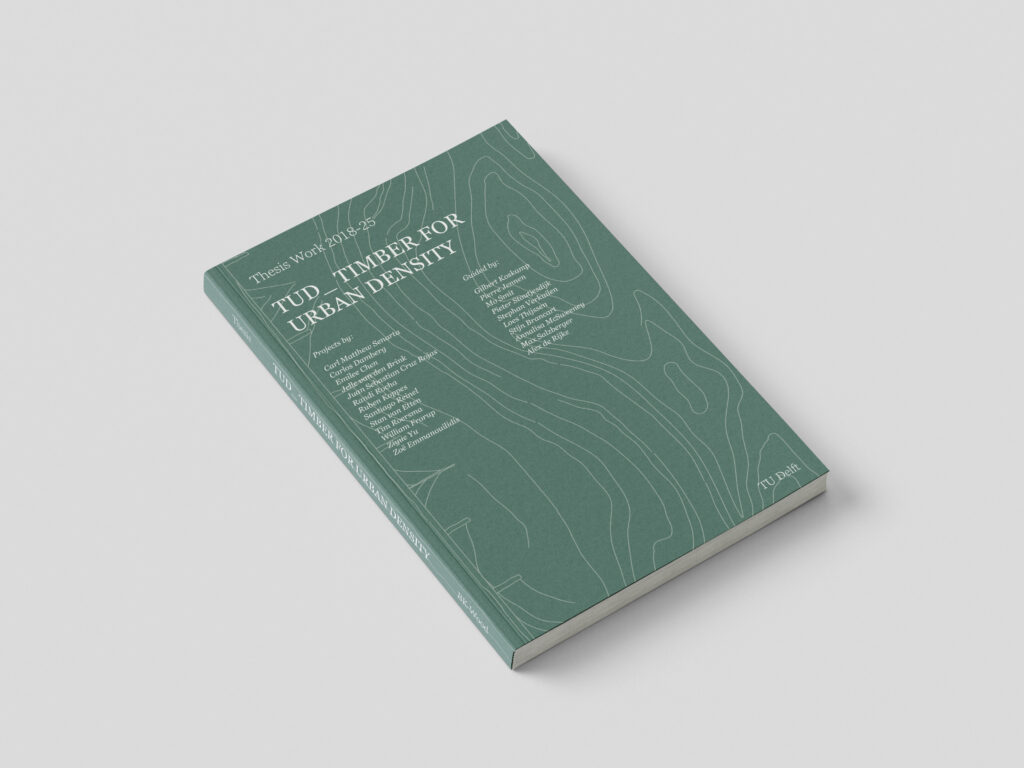
Timber for Urban Density showcases a new generation of architectural thinking from TU Delft, where wood becomes both the structure and the story of the sustainable city. Bringing together graduation projects and research from 2018–2025, the book explores how timber can shape adaptable housing, modular rooftop extensions, and resilient infrastructures for growing urban environments. Through essays, prototypes, and full-scale studies, it connects architectural education with circular construction, emphasizing reversibility, material traceability, and carbon intelligence as design fundamentals. From tropical dwellings and community frameworks to high-rise experiments and bamboo innovations, Timber for Urban Density reveals how the city itself can be reimagined as a living forest, one built from renewable resources, designed for reuse, and crafted with clarity and care. It’s both a vision and a guide for architects who want to build the next generation of circular, low-carbon urban architecture.
#urban timber #reversibility #sustainable city
Soft cover: 172 pages / English / 176 x 250 mm
ISBN: 978-90-83621-04-3
€ 24.50
Additional information
This volume presents “Timber for Urban Density,” a TU Delft compendium of graduation projects and research (2018–2025) that position wood as structural method, urban resource, and cultural project. It advances a pedagogy where drawing, prototyping, and full-scale coordination are inseparable, and where reversibility, traceability, and life-cycle literacy shape detail and assembly. The book is organized around built proposals and essays that translate circular ethics into construction logic and city-scale policy. Design theses test timber across climates and programs: intergenerational housing frameworks and adaptable domestic typologies; neighbourhood top-ups that treat the city as forest through modular rooftop extensions; tropical dwellings negotiating humidity, rainfall, and craft; and resilient community infrastructures whose components are graded for reuse. Collectively they foreground demountable joints, stock-aware dimensioning, and serviceable layers that keep structure legible and teachable. Research chapters consolidate the operating system for practice. A “transparent guide” for Dutch timber construction couples maximum carbon storage with minimum embodied energy; a parametric high-rise study shows how layout and material choice drive footprint; bamboo and wood-technology papers extend the palette with moisture-induced joinery and multi-storey tropical systems; additional essays integrate forest ecologies into urban planning and probe acoustic performance in timber interiors. Together they outline standards, testing pathways, and stock-discretion methods that convert irregular urban feedstock into calculable, re-deployable elements. The result is a clear call to action: design to the available stock, standardize where it counts, keep connections reversible, and align architectural expression with ecological accountability.
Design:
Benedetta Rizzo, Santiago Reinel, Gilbert Koskamp
Editing:
Benedetta Rizzo, Gilbert Koskamp
Printing and Binding:
OnlyPrint B.V.
Publisher:
BK-Wood Books
Publishing Partner:
Delft University of Technology
Powered by:
PEFC, TU Delft, Syntrus Achmea, Ssse|OvO
Printed on PEFC certified paper.
All rights reserved. No part of this publication may be reproduced or reprinted or utilised in any form without prior permission in writing from the author or publisher. Picture copyright are reserved to authors and contributors, unless otherwise mentioned.
© 2025 (First Edition)
ISBN 978-90-83621-04-3